
Do Wooden Fountain Pens Crack?
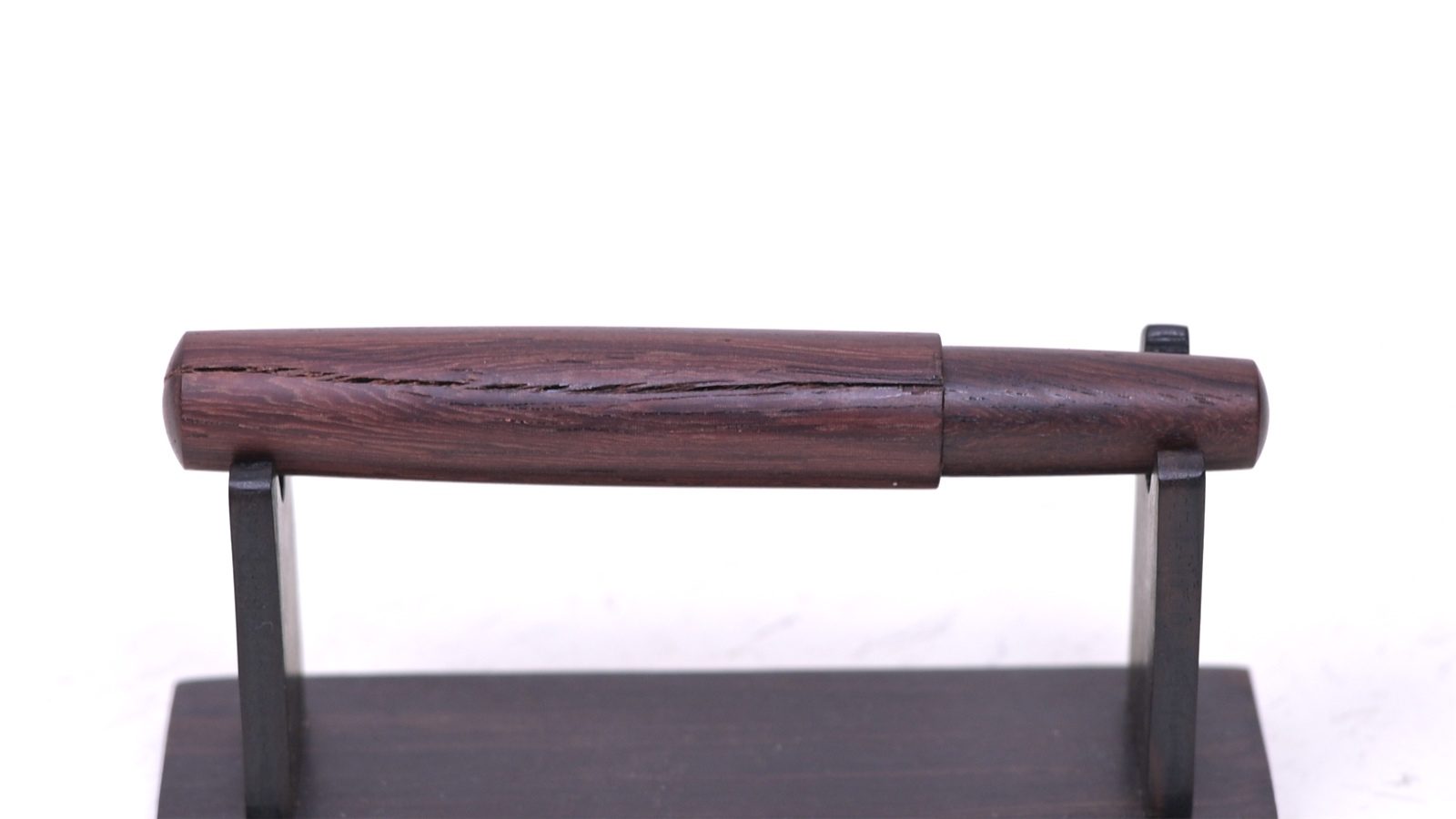
Yes, they can.
Wood is a natural material, so a wooden fountain pen is more likely to crack than a pen made from metal or plastic. There is no reason to avoid talking about this. Anyone interested in owning a wooden pen should understand that the possibility exists.
Wood can crack for several reasons.
The first is the choice of material. Some woods may be beautiful or valuable, but that does not necessarily mean they are suitable for making fountain pens. Agarwood, for example, can be relatively soft. It may be wonderful for carving or collecting, but it is not always a good choice for a pen that will be held, carried and opened every day.
The second reason is using wood that is still too fresh.
Fresh wood contains a relatively high amount of moisture. If it is made into a pen before it has dried properly, it will continue losing moisture afterward. As the wood dries, it can shrink, change shape and eventually crack.
Climate is another factor.
Changes in temperature and humidity affect wood. The risk can be greater when a pen is made in one climate and then shipped to a place that is much colder or drier. Leaving a wooden pen in direct sunlight, beside a heater or inside a hot car can also expose it to sudden and unnecessary changes.
Sometimes the problem is already hidden inside the wood.
A piece of timber may contain a small internal crack or another weakness that cannot be seen from the outside. The pen may look perfectly fine when it is finished. After the wood continues adjusting to its new environment, however, that hidden weakness may slowly become visible.
So how do we reduce these risks?
It begins with choosing the right wood.
We first consider whether a particular species is actually suitable for a fountain pen. Not every rare or expensive wood is suitable. The material needs enough hardness and stability to withstand machining, repeated opening and closing, and normal daily use.
We generally use older wood that has been left to air-dry naturally for several months, and sometimes for several years. Compared with fresh timber, this wood has had much more time to lose moisture and settle. That does not make cracking impossible, but it makes the material considerably more stable.
The next inspection happens during machining.
Before a piece of wood is turned, we can only see its surface. As we begin cutting into it, the internal grain, small cavities and hidden damage gradually become visible. If we find a serious weakness, we stop using that piece. Even if a lot of work has already gone into it, it should not become a finished pen.
Careful selection and machining reduce the risk, but wood is still wood. How the pen is used and cared for also matters.
We have sold our pens to customers in Northeast China. For readers outside China, this region has long, severe winters. Temperatures in its colder northern areas can fall below −30°C, and sometimes approach −40°C, which is −22°F to −40°F. People also move frequently between very cold outdoor conditions and heated indoor rooms, so the pen may experience both large temperature changes and very dry indoor air.
We also have customers in Xinjiang, in northwestern China. Xinjiang is a vast region with a dry continental climate. Some of its desert and basin areas have very low humidity, with large differences between daytime and nighttime temperatures as well as between summer and winter.
These are two different tests for wood. Northeast China brings severe cold and large indoor-to-outdoor temperature changes. Parts of Xinjiang bring extremely dry air and wide temperature swings.
From the feedback we have received so far, our pens do not automatically crack simply because they are used in a cold or dry region. With normal use and reasonable care, they can remain stable in both environments.
The simplest way to care for a wooden pen is to use it.
Take it out, write with it and handle it regularly. The small amount of natural oil from your hands, together with regular handling, helps maintain the surface and allows the pen to develop its own signs of use.
At the same time, try to avoid extreme conditions. Do not leave the pen outdoors for long periods, in direct sunlight, beside a heater or inside a car that may become very hot. Under normal indoor conditions, with regular use, most wooden pens should not have a problem.
We also provide a practical guarantee. If a pen develops a crack within one month of delivery under normal use, rather than through accidental or deliberate damage, we will replace it or provide a refund at no cost.
In our experience, if a pen has gone through shipping and adjusted to the customer’s local climate without cracking during the first month, the chance of it cracking later under normal use becomes much lower. We still would not claim that a piece of wood can never crack. Wood is not an entirely uniform material, and no responsible maker should promise that it will behave exactly like metal or plastic forever.
Anyone who wants to own a wooden fountain pen should have some understanding of this.
Wood is not perfectly consistent. Every piece has its own grain, colour, density and internal structure. No two pens will be exactly the same, and not every part of a wooden pen will look perfectly uniform.
That is also where its character comes from.
If you love wood, you have to accept some of what makes it wood.